
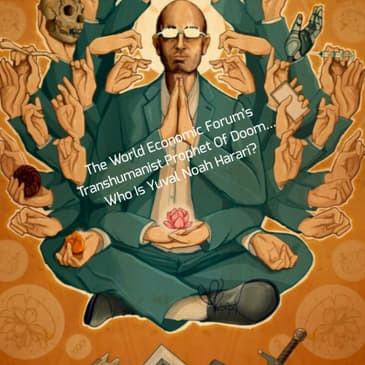
Who is Yuval Noah Harari? What does the World Economic Forum's "advisor" believe in and represent?
https://www.alchemicaltechrevolution.com
https://www.anchor.fm/wayne-mcroy
Become a Paid Subscriber:
https://anchor.fm/wayne-mcroy/subscribe
https://www.youtube.com/channel/UCSdS1CiIycQRaSy2UupPrzg
https://www.amazon.com/Books-Wayne-McRoy/s?rh=n%3A283155%2Cp_27%3AWayne+McRoy
https://m.facebook.com/Files-From-The-Conspiratorium-1542730889274114/
thealchemicalbeacon.substack.com
https://my-store-d08567.creator-spring.com/listing/atr-design-1
https://my-store-d08567.creator-spring.com/listing/atr-design-2
If you would like to make a one time donation, you can send it through PayPal to:
[00:00:00] We lead the world in facing down a threat to decency and humanity.
[00:00:05] What is it today?
[00:00:07] It is more than one of the phones that's on the phone.
[00:00:12] It is a big idea.
[00:00:14] It has a repression.
[00:00:15] Has new, more than one good and hard side with the voice.
[00:00:19] Every range of things we gather inside the church.
[00:00:21] We're sure to put a little gathering inside the church.
[00:00:23] We're faithful, so to say. And I'm here to tell you tonight, ladies and gentlemen, that nothing could be further from the truth. This guy is Lockstalk and Barrow, a transhumanist to the core, and represents all of the heinous
[00:01:41] philosophies that go right along with the rollout of the four IR, the fourth industrial revolution. So make no mistake about it, this guy, he's not our friend, okay? And maybe he's out
[00:03:01] there saying some things to make it sound as if, oh well we're trying to warn you, but that's always doctorate and philosophy degree at Jesus College and Oxford in 2002 under the supervision of Stephen J. Gunn. He holds a Yad Hanadiv fellowship. It says at Oxford. He encountered the writings of Jared Diamond who he has acknowledged as an influence on his own writing. At a Berghruin Institute salon
[00:04:22] Harari said that Diamond's guns, germs, might be some kind of a good thing. He also had a follow-up book to that first book we just named and this one's called Homo Dias, a brief history of tomorrow and that one was published in 2016 around the same time that he produced this article for New Statesman magazine and that Salvation by Algorithm, God, Technology, and the New 21st Century Religions With its world-changing inventiveness, technology has become the force religion once was, by Uval Harari. More than a century after Nietzsche pronounced him dead, God seems to be making a comeback.
[00:07:03] But this is probably a mirage. in this article and its direct correlation to transhumanism here in the article. So here it is and this guy was quoting Nietzsche, Friedrich Nietzsche, who said in 1882, God is dead and he made the argument that God is dead in his work the Gay Science. Mr. Harari says the same thing,
[00:08:21] he says God is dead, it's just taking a long time here on earth with the help of technology, rather than after death and with the help of supernatural beings. And it says in parentheses here, of course, this does not mean that these techno religions will fulfill all their extravagant promises. Religions spread themselves more by making promises than by keeping them.
[00:09:44] I'm going to pause after that paragraph here now too, folks. These modern creeds prefer to call themselves ideologies rather than religions, but seen from a long-term perspective, they play a role analogous to that of traditional faiths such as Christianity and Hinduism. Both Christianity and communism were created by human beings rather than by gods and are defined by their social functions
[00:11:04] rather than by the spirit of what he's representing here? Do you sense what this is? Could you feel it in your bones? That something this guy's saying does not sit well with the human soul?
[00:12:24] I think we all need to do a lot of contemplating questions such as, who am I? What is the meaning of life? What is good? Whereas most people accept the ready-made answers provided by the powers that be, spiritual seekers are not so easily satisfied. They are determined to follow the big question wherever it leads, and not just to places they know well or wish to visit. Often enough, one of the most important
[00:13:43] obligations for spiritual wanderers is to challenge the beliefs and conventions of dominant their own affinity to become something divine or to become God themselves. They don't espouse a necessarily a belief in a God of any sort or of a supernatural creator of this this world that we live in, but they think that humankind himself can become a God through the use of high technology, through the use of his intellect, and this is the
[00:16:06] laws, institutions, and rituals of the Catholic Church, found himself writing new law books, founding new institutions, and inventing new ceremonies.
[00:16:10] It happened even to the Buddha and Jesus.
[00:16:13] In their uncompromising quest for the truth, they subverted the laws, rituals, and structures
[00:16:19] of conventional Hinduism and Judaism.
[00:16:21] But eventually, more laws, more behaviors. Let's read on.
[00:17:40] Because they are human creations that seek to cater to human fears and technology, religious ideas and technology, he's pairing them together in certain ways here. All right, he's saying technologies are tools. He's not incorrect with that. That can be used in certain ways and some kind of quote-unquote priest craft would be the ones that would have to direct the direction in which these technologies are used and
[00:19:02] you could see some of the subtle innuendo being
[00:20:07] further here. How he argues these points that he makes. He does so through the lens of a historian in a sense, because that's what he has his PhD in history from Oxford University nonetheless,
[00:20:13] which is one of the major Ivy League schools in this world that really pushes out the indoctrinated
[00:20:20] class. Okay, the the elit have none. Let's what he's doing here. He's using something here. He's taking a scripture from the Bible, quoting it out of context to back up the point he's trying to make, to make it look like he's an authoritative source on this and that the
[00:23:03] Bible backs him up on this.
[00:23:05] Why would you do this. So now he's using the Bible to back up his idea to try to give himself more credibility, even though he firmly and staunchly is against many of the things taught in the Bible. You could see this through the hubris here. He doesn't believe these things.
[00:24:20] He thinks it's foolishness, but he's willing to use it out of context to try to convince
[00:24:24] people that may believe a little something about, artificial ones, all of the artificial things. See, this is all about going against the natural order with these people. Artificial fertilizer, industrial insecticide, genetically modified crops. It's a spit in the eye to the creator,
[00:25:40] all of these things.
[00:25:41] And he's saying that this is superior to anything
[00:25:44] that the God of the Old Testament produced back in the culture. They understood farming. They understood agriculture. So a lot of the allegories and the stories they told related to things they were familiar with. Okay, this is what would be called parables. This is how Jesus taught back in the Bible. He taught in parables so people could understand things a little bit better because he taught
[00:27:01] it in a way in which they were familiar of it remarkably different things. New technologies kill old gods and give birth to new gods. That is why agricultural deities were different from hunter-gatherer spirits, why factory hands and peasants all of this, what this guy represents. What it is he's pushing and out there promoting. This doesn't sound like a guy that's on our side to me. It doesn't sound like he's pro-human to me. He's talking about useless people, economically useless people. What a way to phrase things here.
[00:29:42] This is like, I can't even begin to fathom how to explain be the kind of intent behind this. You could see the spirit that underlies this whole thing. And this goes along with transhumanism in general. It's not the spirit of God behind it. It's not the next step in human evolution. It's not the way forward for mankind. It does not. The remaining productive class and the new useless class. It's going to open unprecedented gaps between the rich and poor. So this is going to create further division between the class structure. And we're seeing that unfolding before our
[00:32:21] eyes today, aren't we? We see this wealth disparity between the wealthy
[00:32:26] individuals and the rest of the under ideas. They call it, in their own words, eugenics without coercion. That's what they're lining up here, folks. So the useless class, are you going to be part of the useless class?
[00:33:43] So they call you? the Bible and the Confucian Analects, but because nobody in the medieval Middle East nor anyone in ancient China knew much about computers, genetics or nanotechnology. Radical Islam may promise an anchor of certainty in a world of technological and economic storms, but in order to navigate a storm, you need a map and a rud ideas better than we do now. If you look back at the different evidence of this, if you look at some of the older philosophies and sciences that have been brought forward, there's much value to be garnered there. And this guy's throwing that to the back burner and disregarding it. At least that's the public opinion he's giving here.
[00:36:20] Or that's the impression he's giving.
[00:36:22] So let's read on.
[00:37:25] to believe in the Vedas, the Bible, and the Quran more than in the steam engine. As of today, so too in the nineteenth century, there was no shortage of priests, mystics
[00:37:30] and gurus who argued that they alone hold the solution to all humanity's problems.
[00:37:36]