Reading from, "The Reign Of Quantity and The Signs of The Times", by Rene Guenon... https://www.alchemicaltechrevolution.com
https://www.anchor.fm/wayne-mcroy Become a Paid Subscriber:
https://anchor.fm/wayne-mcroy/subscribe
https://www.youtube.com/channel/UCSdS1CiIycQRaSy2UupPrzg
https://www.amazon.com/Books-Wayne-McRoy/s?rh=n%3A283155%2Cp_27%3AWayne+McRoy
https://m.facebook.com/Files-From-The-Conspiratorium-1542730889274114/
thealchemicalbeacon.substack.com
https://my-store-d08567.creator-spring.com/listing/atr-design-1
https://my-store-d08567.creator-spring.com/listing/atr-design-2
https://freeworld.fm/ If you would like to make a one time donation, you can send it through PayPal to: dmcroy98@epix.net
[00:00:00] We lead the world in facing down a threat to decency and humanity.
[00:00:30] You're listening to the Alchemical Tech Revolution and I am your host Wayne McRoy.
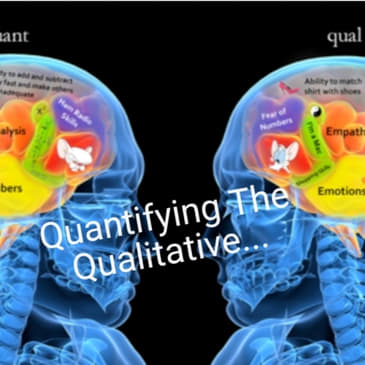
[00:00:57] Good evening everyone. Tonight we're going to discuss quantifying the qualitative of quantity and quality are two separate things but they do fall along the same lines of polarity,
[00:01:13] the polarity principle at play and this is something fundamental to the operation of things in this world.
[00:01:23] And we have those in this world in positions of power who have a vested interest in trying to quantify everything in order to instantiate control over everything.
[00:01:35] So even these qualitative factors, these experiential or subjective things they will attempt to quantify in some way.
[00:01:46] If you can measure something then you can effectively come up with means of controlling that something and that is what is at the heart of cybernetics methodologies.
[00:02:02] Cybernetics being an important concept here as we shall see as we get into our reading here today.
[00:02:12] And we're going to be actually reading from a book titled The Rain of Quantity and the Signs of the Times by Renee Guanan.
[00:02:22] It's an interesting read for certain. This guy had a profound understanding of a lot of different philosophical and occult subjects as well as the scientific approach to these things.
[00:02:40] And he had an interest in exploring the writings of secret society groups and occult fraternities much like myself.
[00:02:50] And he offered some valuable analysis of many of these things and that's why it's important that we go through this.
[00:03:00] It's an important concept to understand because even though those things that derive from qualitative perspectives,
[00:03:19] even though they are something subjective, they can effectively be quantified in some way and some measure of control can be applied thereof.
[00:03:29] And this all falls on that polarity spectrum, quantity, quality. It's a philosophical principle that goes back a very long time.
[00:03:37] And having a key understanding of this is important to seeing what methods have been applied in the modern era, to effectively steer our society and our culture.
[00:03:50] To control our world, there are darker cultists at the top of the power structure in this place that leverage these principles in certain ways.
[00:04:00] Of course, there are there minions beneath them who perhaps unknowingly contribute to this state of affairs.
[00:04:10] And oftentimes what has happened is a very small select few people have garnered a lot of power in this world by understanding these principles and applying them against the masses.
[00:04:24] So that's what we're going to be discussing here. This difference between quantity and quality, how it falls on the same polarity spectrum and how these things have been weaponized against us and how they actually manifest in the reality in which we live.
[00:04:42] So it's an important study here to be done. And I think having a better understanding of this is key to seeing what's been done in the name of quote unquote science or the quote unquote greater good in our world.
[00:04:59] Certainly, the social engineering of the masses has utilized these principles as utilize this polarity principle.
[00:05:11] So without further ado, let's get into it.
[00:05:19] Quality and quantity are fairly generally regarded as complementary terms, although the profound reason for their complementarism is often far from being understood.
[00:05:30] This reason lies in the polar correspondence referred to in the introduction of this book, going to pause for a moment here folks.
[00:05:39] So Renegu-Anne lays down the foundation here by claiming that the qualitative and the quantitative fall on the same polarity spectrum.
[00:05:51] There's a correspondence, a polar correspondence between them much like between black and white, hot and cold.
[00:06:01] All of these philosophical principles we've looked at in the past all of these hermetic principles.
[00:06:07] We've looked at in the past. These things that are symbolized in the Masonic tile floor with the black and white checkerboard pattern.
[00:06:18] You see that is the lines on which quantity and quality fall.
[00:06:23] They are polar opposites on a spectrum, and they can be leveraged towards the center, and that's what is done largely in this world to bring about changes.
[00:06:42] So let's go ahead and read on here.
[00:06:44] This, the first of all cosmic dualities, is a starting point where it is situated at the very principle of existence or of universal manifestation.
[00:06:53] And without it no manifestation would be possible in any mode whatsoever.
[00:06:58] It is the duality of the perusha and procreate according to the Hindu doctrine, or to use another terminology that of essence and substance.
[00:07:10] I'm going to pause for a moment here, folks.
[00:07:12] So this is essential to manifestation here in this reality.
[00:07:17] All things have a quantitative factor and they also have a qualitative factor.
[00:07:23] More simply substance and essence.
[00:07:27] Substance would be the physical manifestation of a thing.
[00:07:32] Essence would be the spiritual manifestation of a thing.
[00:07:36] You see, you could break this down on all these different lines of reasoning and thinking.
[00:07:42] Substance would be the quantitative aspect, and essence would be the qualitative aspect.
[00:07:51] Let's read on.
[00:07:54] It's two terms must be envisaged as universal principles and as being the two poles of all manifestation.
[00:08:01] But at another level, or rather at a number of different levels for there are many levels corresponding to the more or less particularized domains,
[00:08:09] that can be envisaged in the interior of universal manifestation.
[00:08:13] These two terms can also be used analogically and in a relative sense.
[00:08:19] In order to designate that which corresponds to the two principles or most directly represents them with reference
[00:08:26] to a particular more or less limited mode of manifestation.
[00:08:31] Thus, it is that essence and substance can be spoken of in relation either to a world,
[00:08:38] that is to say, to a state of existence determined by certain special conditions,
[00:08:43] or in relation to a being considered as a separate entity,
[00:08:48] or even to each of the states of that being, that is to say to its manifestation in each of the degrees of existence.
[00:08:56] In this last case, there is naturally a correspondence between what essence and substance represent in the microcosm
[00:09:05] and what they represent considered from a macrocosmic point of view,
[00:09:10] in the world in which the manifestation of the being is situated.
[00:09:14] In other words, they are then only particularizations of the relative principles,
[00:09:20] which are the determinations of universal essence and substance in relation to the conditions of the world in question.
[00:09:28] And I'm going to pause again just to kind of expound on this and break down some of this for you.
[00:09:36] What Winnon is talking about here is the very thing that manifestation represents,
[00:09:49] its essence and substance together.
[00:09:55] And he's speaking of the microcosmic and the macrocosmic scale.
[00:09:59] An individual would be the microcosm,
[00:10:02] and the world or the universe at large would be the macrocosm.
[00:10:05] And one reflects the other in many regards,
[00:10:09] this is the whole hermetic principle of correspondence as above so below,
[00:10:15] as within so without what happens in the microcosm happens in the macrocosm,
[00:10:21] the big picture and the little picture,
[00:10:25] there are reflections of one another.
[00:10:29] And this is why man-made ideas like quantum theory don't stand up to scrutiny,
[00:10:37] because it does not reflect the macrocosmic aspect of things.
[00:10:42] Things don't happen differently on these small scale than they do on the big scale.
[00:10:47] We have universal laws, we have fundamental natural laws that affect this place in which we live,
[00:10:55] and they correspond one to another on the small scale and the large scale.
[00:11:00] So therefore this grand unified theory of physics that our modern science tries to put together
[00:11:06] by linking quantum ideas with what they have termed relativistic ideas now,
[00:11:15] they don't jive, they know they don't jive,
[00:11:17] and everything they do to try to make them jive doesn't seem to work.
[00:11:21] That's because there's something flawed in the thinking of how they approach these things,
[00:11:28] because we do have this principle, this old hermetic principle that has been time tested
[00:11:35] and proven time and again throughout all of the history of mankind.
[00:11:40] This hermetic correspondence principle as above so below,
[00:11:45] as within so without, I think it's demonstrable at this point.
[00:11:52] But anyway they try to violate this principle by applying two separate forms of quantification
[00:12:04] to these different aspects of reality.
[00:12:07] And this is where they get it wrong but once again it is the attempt to quantify something
[00:12:12] that is largely qualitative, something that they cannot understand on a substance level,
[00:12:21] but does have an essence level to it.
[00:12:24] So the attempt to quantify the essence is what's been done here.
[00:12:31] So when they're talking about quantum things,
[00:12:35] they're trying to quantify the essence of a thing which is very different from the substance of a thing.
[00:12:42] It's not something that can be easily done,
[00:12:45] and in so doing they've created their own types of paradoxes
[00:12:52] that they can't seem to come to grips with.
[00:12:57] And this is the important aspect of this.
[00:13:02] You see they're trying to disregard this natural law, this natural principle.
[00:13:07] This principle of correspondence, the law of analogy has sometimes been called.
[00:13:15] And it's something that has permeated philosophy for all time,
[00:13:20] for as far back as we could look.
[00:13:24] They've largely tried in the modern era to disregard philosophical principles like this.
[00:13:31] But they wind up having failures because of their lack of acknowledging these things.
[00:13:42] So at any rate we see here that the questions of essence and substance are at the heart of all of this.
[00:13:55] And they fall on a spectrum. They are polar opposites, essence and substance.
[00:14:01] Much like everything else in this world, and some of the philosophers and some of the occultists will call this duality.
[00:14:10] I think polarity is the better word.
[00:14:15] There's some difference in nuance of language between the terms duality and polarity.
[00:14:23] And duality does not stand to scrutiny when you're looking at the semantics of what the term is supposed to mean.
[00:14:33] But polarity does seem to hold up.
[00:14:36] We can understand polarity, the positive and negative pole of things.
[00:14:41] Well, quantity and quality are those positive and negative poles.
[00:14:47] When it comes to the manifestation thereof in this reality.
[00:14:54] So let's go ahead and we'll get back to the reading here.
[00:14:58] Understood in this relative sense, and especially with reference to particular beings,
[00:15:03] essence and substance are in effect the same as the form and matter of the scholastic philosophers.
[00:15:11] But it is better to avoid the use of these latter terms because doubtless owing to an imperfection of the Latin language in this connection,
[00:15:19] they only convey rather inaccurately the ideas they ought to express.
[00:15:24] Also because they have lately become even more equivocal by reason of the quite different meaning commonly assigned to them in current speech.
[00:15:35] However, that may be to say that every manifested being is a composite of form and matter amounts to saying that its existence necessarily proceeds simultaneously from both absence and substance.
[00:15:49] And consequently, that there is in each being something corresponding both to the one and to the other of these two principles,
[00:15:58] in such a way that the being is as it were a resultant of their union or to speak more exactly,
[00:16:05] a resultant of the action exercised by the active principle essence on the passive principle substance.
[00:16:13] And if consideration is confined to the special case of individual beings,
[00:16:18] the form and the matter which constitute those beings are respectively identical with what the Hindu tradition designates respectively as a nama and rupa.
[00:16:31] I'm going to pause for a moment there, folks.
[00:16:35] So we have Guinnan here naming matter and form.
[00:16:43] I would substitute the term spirit for one of those because form and matter in the modern context kind of mean the same thing.
[00:16:54] So he's talking about the essence and the substance, the substance being that which is quantifiable, the essence being that which is a qualitative thing which is not quantifiable.
[00:17:08] So I would use the terms spirit and form.
[00:17:12] And it's this constantiation between spirit and form which manifests as consciousness in this reality.
[00:17:22] And this falls in that spectrum, that is this polarity principle between the quantitative and the qualitative between spirit and form or essence and substance.
[00:17:37] I like those terms, essence and substance.
[00:17:40] The substance is the quantifiable matter of a thing and the essence is that spiritual component which can't be easily measured.
[00:17:51] Which can't really be accounted for in some other way.
[00:17:55] There's a lot of things in this world that you could use as an analogy for this.
[00:18:02] A lot of different things like for instance, let's look at something that is stumped mankind for ages on told and still continues to do so today.
[00:18:10] A magnet.
[00:18:12] What makes a magnet a magnet?
[00:18:16] Well, it's not the substance. It's a qualitative thing. It's the essence of the magnet which applies this magnetic field to it.
[00:18:26] You see they can't physically account for what is the substance that makes a magnet a magnet.
[00:18:32] It is quantitatively identical to a non-magnet of the same material.
[00:18:40] It's a qualitative thing that they don't really understand.
[00:18:44] So this is an essence, a question of essence rather than substance.
[00:18:51] And that is a good analogy here.
[00:18:55] What makes a magnet a magnet? What makes consciousness, consciousness?
[00:19:00] Well, it's not something that could be measured in a quantitative type of way.
[00:19:07] It's an essence, not a substance.
[00:19:11] And our modern science falls far short of being able to expound upon the nature of essence.
[00:19:20] That doesn't stop them from trying to quantify essence though does it.
[00:19:26] And certainly they've come up with mathematical reifications to do so, to measure these things because as we've discussed in the past here,
[00:19:36] if you can measure a thing, if you can count a thing, if you could quantify a thing, that gives you some type of control over that thing.
[00:19:45] Whether it be a precise control or an imprecise type of control.
[00:19:51] So even if it's an inexact measurement that they are able to obtain by doing this,
[00:19:56] it still gives them something they could work with to steer things in a generalized direction.
[00:20:01] That is why they seek to quantify everything in this world.
[00:20:05] They seek to utilize this polarity principle between the essence and the substance to steer things in certain directions,
[00:20:13] to try to steer the essence in certain directions by affecting the substance.
[00:20:19] Now certainly we see this going on today.
[00:20:23] They try to affect the human mind in certain ways.
[00:20:27] How so? Well they try to affect the human mind by affecting the human brain, the physical substance which houses the essence that is mind.
[00:20:39] At least that's what they think.
[00:20:42] And at least that seems to be what is accepted, that the brain is the physical housing of the mind.
[00:20:53] And being the physical housing of the mind, if you affect that physical housing, the substance, then in turn you affect the essence.
[00:21:02] It's the correspondence principle you see.
[00:21:05] The old hermetic axiom has above so below, you can affect one thing by affecting the other.
[00:21:12] It's almost like that reflection principle as well, that we see the mirror principle.
[00:21:19] The physical can mirror the spiritual and the spiritual can mirror the physical.
[00:21:26] So what you affect one, you affect the other.
[00:21:28] Now usually according to the occultists, the way manifestation occurs, it occurs first in the more spiritual realms,
[00:21:36] and then it reflects down below here in the physical.
[00:21:41] However, you can work this in reverse order to affect the other side with these things.
[00:21:47] That's why they seek to alter human physiology, human anatomy.
[00:21:55] In order to affect human consciousness, to affect the spirit, they affect the body to affect the spirit.
[00:22:04] I hope you're understanding what I'm presenting here.
[00:22:11] To affect the whole system, you just affect the one part of it.
[00:22:15] And if you can accept this universal truth that we have essence and substance as a polarity principle that is a first cause,
[00:22:27] affecting one will affect the other.
[00:22:30] And that's what Mr. Guadanaan is trying to present here.
[00:22:34] Let's read on.
[00:22:36] Well, on the subject of concordances between different terminologies, thus perhaps incidentally enabling some people to translate the explanations given into a language to which they are more accustomed,
[00:22:48] it may be added that the Aristotelian designations act and potency also correspond to essence and substance.
[00:22:58] Aristotel's terms are susceptible of a more extended application than are the terms form and matter, or form and spirit.
[00:23:07] I would say.
[00:23:09] But to say that there is in every being a mixture of act and potency comes back to the same thing in the end,
[00:23:16] for act is that in him by which he participates in essence, and potency is that in him which he participates in substance.
[00:23:26] Pure act and pure potency could not exist anywhere in manifestation since they are true equivalents of universal essence and substance.
[00:23:35] Gonna pause for a moment here, folks.
[00:23:38] So now Guadanaan will invoke the works of Aristotle, Aristotle called essence and substance.
[00:23:45] Something else, he called them potency and act.
[00:23:54] So there's different language that's been expressed through the course of time describing this.
[00:23:59] I do like the terms essence and substance, though, because I think we could all get a better grasp of those two terms.
[00:24:07] So we'll try to stick to those in describing these things, and I think Guadanaan does stick to those by a large.
[00:24:13] But he's just pointing out that philosophers of the past have asked these questions as well,
[00:24:21] and have also come to the same understanding that the quantitative and the qualitative can affect one another,
[00:24:30] that it lies on a spectrum, a polarity.
[00:24:35] And that the cause and effect sequences of this reality can be invoked by using or utilizing either of these principles,
[00:24:45] the substance or the essence.
[00:24:48] Let's read on here, though.
[00:24:50] Provided that this is clearly understood it is possible to speak of the essence and of the substance of our world.
[00:24:56] That is of the world which is the domain of the individual human being.
[00:25:00] And it can be said that in conformity with the particular conditions which define this world as such,
[00:25:06] these two principles appear in it under the aspects of quality and quantity, respectively.
[00:25:14] This may appear evident at first sight, so far as quality is concerned since essence is the principle synthesis
[00:25:22] of all the attributes which belong to a being and make that being what it is,
[00:25:27] and since attributes and qualities are really synonymous,
[00:25:30] and it may be observed that quality considered as the content of essence,
[00:25:35] if such an expression be allowable, is not exclusively confined to our world,
[00:25:41] but is susceptible of a transposition which universalizes its significance.
[00:25:47] There is nothing remarkable in this since essence represents the superior principle,
[00:25:53] but in any such universalization quality ceases to be the correlative of quantity,
[00:25:59] for quantity unlike quality, is strictly linked up with the special conditions of our world.
[00:26:06] Furthermore from a theological point of view, it is not quality in some way brought into relation with God himself,
[00:26:14] when his attributes are spoken of,
[00:26:16] whereas it would be manifestly inconceivable to pretend to assign to him any sort of correspondent
[00:26:22] quantitative determination, going to pause for a moment here folks.
[00:26:27] God is essence, is spirit, does not have a substance correspondence down here,
[00:26:38] except for in certain regards the human being himself as a microcosmic reflection
[00:26:47] of this macrocosmic type of principle, if you want to look at it from that perspective.
[00:26:55] But you see we cannot accurately represent the qualitative essence that is God in a substantive form.
[00:27:08] That's why we are told in the Bible not to worship idols,
[00:27:18] or to make graven images.
[00:27:21] That's where the Muslim tradition of not making any image of Allah or God,
[00:27:31] a graven image comes from, because you can't accurately depict the qualitative aspect of God in a quantitative way.
[00:27:45] And it's acknowledged through the various religious theological viewpoints in that way.
[00:27:52] That's why it said don't make a graven image, do not worship idols, things that represent this principle of God in a substantive form.
[00:28:07] That's where those traditions come from.
[00:28:12] But at any rate let's continue here.
[00:28:17] To this the objection might perhaps be raised that Aristotle ranks quality as well as quantity among his categories,
[00:28:25] which are only special modes of the being and not co-extensive with it.
[00:28:29] He does so however without affecting the transposition previously mentioned.
[00:28:34] Indeed he has no need to affect it for the enumeration of his categories relates only to our world and to its conditions.
[00:28:43] In such a way that quality cannot be and is not really meant to be understood otherwise,
[00:28:49] then in a sense that is more immediate for us in our state as individuals, the sense in which as explained earlier,
[00:28:57] it appears as a correlative of quantity.
[00:29:01] It is of interest to note on the other hand that the form of these scholastics is what Aristotle calls species
[00:29:10] and species is properly speaking a nature or an essence common to an indefinite multitude of individuals.
[00:29:19] Specific nature is of a purely qualitative order for it is truly innumerable in the strict sense of the word,
[00:29:28] that is to say it is independent of quantity being indivisible and entire in every individual belonging to the species
[00:29:36] so that it is quite unaffected by the number of those individuals and a plus or minus cannot be applied to it.
[00:29:43] Moreover species is etymologically the idea, not only in the modern psychological sense but also in an ontological sense,
[00:29:53] never then is our ordinarily supposed to the sense in which Plato uses it for whatever may be the real differences in this connection between the conceptions of Plato and Aristotle
[00:30:05] as so often happens they have been greatly exaggerated by disciples and commentators.
[00:30:11] The platonic ideas are also essences.
[00:30:15] Plato gives expression chiefly to the transcendent aspect and Aristotle to the imminent aspect but this does not apply in compatibility.
[00:30:24] Independently of any conclusions to which the systematic spirit may lead, it is only a matter of a difference of level.
[00:30:32] In any case they are always considering archetypes or the essential principles of things such principles representing what may be called the qualitative side of manifestation,
[00:30:44] going to pause for a moment here folks.
[00:30:47] Now Guananan identifies the nature of the archetype, it is a qualitative principle.
[00:30:55] The qualitative side of manifestation that is why archetypes are so heavily utilized by the social engineers and the controllers of this place
[00:31:08] because you see they use them to affect the substance of this place.
[00:31:16] Remember what we said if you affect one side, you affect the other.
[00:31:21] Things that are affected in the spiritual sense can represent or manifest in a physical sense.
[00:31:28] That's why they use archetypes for social programming.
[00:31:33] The archetype is the qualitative aspect that can be leveraged to bring about real change in the substance of this world.
[00:31:46] In the physical and vice versa.
[00:31:53] If you can affectate changes in the physical or the substance, you can also bring about corresponding changes in the spiritual or the essence.
[00:32:03] So they try to utilize both sides of this multifaceted coin to bring about change in this world and it's the understanding of the true nature of cause and effect sequences.
[00:32:15] Like I said most of the occultists in the philosophers acknowledge that manifestation first occurs in the spiritual planes around the spiritual realms and then later begins to manifest in a physical way in this world in which we exist in our reality.
[00:32:35] And it's this substantiation between the essence and the substance that makes that possible.
[00:32:42] You change one, you change the other so they try to work both sides of this to effectuate the changes they want and bring about the agendas they want in this world.
[00:32:53] Now things look more immediate when you affect the substance.
[00:32:58] But if you're doing long term planning to change things, if you change the essence then the substance will eventually show or reflect those changes over the long term.
[00:33:12] That's why they utilize these principles in this way.
[00:33:18] But anyway, let's go ahead and we'll get back to the reading here.
[00:33:24] Furthermore the platonic ideas under another name and by direct affiliation are the same thing as the Pythagorean numbers.
[00:33:34] And this shows clearly that although the Pythagorean numbers, excuse me I said that wrong the first time, Pythagorean numbers are as already indicated, analogically called numbers.
[00:33:46] They are in no way numbers in the ordinary quantitative sense of the word.
[00:33:51] They are on the contrary purely qualitative corresponding inversely on the side of essence to what the quantitative numbers are on the side of substance.
[00:34:03] I'm going to pause for a moment here because this is a hugely important point to make.
[00:34:10] The numbers, numbers as a symbol represent more than just the physical quantity of a thing.
[00:34:19] If you've been listening to this program for any length of time, you understand that.
[00:34:24] You understand that there are other correspondences with these numbers they represent other ideas.
[00:34:31] Other ideas inherent in them.
[00:34:36] Those are just a number of different types of numbers.
[00:34:43] That's what Winnon is pointing out here.
[00:34:48] There's a qualitative aspect to numbers, not just a quantitative one.
[00:34:55] You see how deep this stuff gets.
[00:34:59] It's understood by Pythagoras, who was actually able to put forth a system.
[00:35:07] Enumerating these things in various ways, the qualitative aspects of the numbers.
[00:35:15] So when we're able to look at a number like 9 or 11, we understand that there's more there than just a physical count don't we?
[00:35:25] You see the reflection of the qualitative aspect of it there, just as an example.
[00:35:33] That's something that is massively important to understand because this gets leveraged all the time by these social controllers.
[00:35:39] They know that there are inherent qualitative or essence meanings to these numbers than just the physical substance aspect to them.
[00:35:53] Let's read on here.
[00:35:56] On the other hand, when St. Thomas Aquinas says that numerous St. X part a materia, he is speaking of quantitative number and he thereby affirms decisively that quantity has an immediate connection with the substantial side of manifestation.
[00:36:13] The word substantial is used here because materia in the scholastic sense is not by any means the same as matter, as understood by modern physicist, but is properly substance.
[00:36:26] Whether that word be taken in its relative meaning as when it is put into correlation with formah and referred to particular beings or whether it be taken when materia prima is in question as the passive principle of universal manifestation.
[00:36:42] That is as pure potentiality and so as the equivalent of procreity in the hindru doctrine.
[00:36:49] However, as soon as matter is in question, in whatever sense the word is taken everything becomes particularly obscure and confused and doubtless not without reason, and therefore,
[00:37:01] well, it has been possible to give an adequate account of the relation of quality to essence without developing a long argument.
[00:37:09] It will be necessary to go more deeply into the relation between quantity and substance in order to present a clear picture of the various aspects assumed by the Western conception of matter even before the modern deviation in which this word was destined to play so great apart.
[00:37:27] It is all the more necessary to do so because this question is in a sense at the very root of the principle subject of this triad ease.
[00:37:37] I am going to pause for a moment here.
[00:37:42] Now we are getting down to some of the brass tacks here of what is being presented here in this work.
[00:37:53] You see, it is about the passive principle of universal manifestation.
[00:38:00] The passive principle relates directly to substance.
[00:38:05] If you can effectuate change in this passive principle, you could therefore effectuate change in the active principle in a corresponding type way.
[00:38:16] So if you change the substance, you can change the essence and vice versa.
[00:38:21] Like I said, this is all about control.
[00:38:24] This is all about affecting our reality to bring about certain agendas by those people in control of this world, those dark occultists who run things at the top of the power structure here,
[00:38:37] and perhaps their minions who unknowingly go along with their plans, and bring about the manifestation of these changes in reality.
[00:38:47] By not only affecting the substance but also affecting the essence, now a lot of the social programming that goes on is due to the effects on the essence.
[00:38:59] The essence being affected,
[00:39:04] largely by news media and entertainment media,
[00:39:13] leveraging archetypes to resonate in the essence of individuals creating change in the essence in the thought patterns
[00:39:31] in the essence of a being which manifests here in a substantive way in this reality at some point.
[00:39:38] Over the long term, you see if you want to affect social behavior and society over the course of long term timing,
[00:39:47] you affect the essence.
[00:39:50] If you want to do something in the short term, you affect the substance.
[00:39:55] That's what these social programmers of this world have understood for a long time.
[00:40:00] If they want to bring about relatively quick change, rapid change, they will affect the substance, the physical in some way to begin to make the transformation.
[00:40:18] Now if they're planning long term, they affect the essence and the change will be brought about that way.
[00:40:27] I hope I'm not speaking over your head, I hope you could see just how nefarious this can become in the hands of the wrong people.
[00:40:35] And certainly it's the wrong people that have been in control for a long time here who have understood these principles and affected us with them.
[00:40:45] And we do know that these power players, these darker cultists who run things in this world, they play the long game.
[00:40:53] So they attempt to affect the essence to bring about the corresponding change here in the substance and the physical, leveraging archetypes against human consciousness.
[00:41:09] But sometimes they want to speed their plans up.
[00:41:14] And to speed their plans up, they will bring about some change in the substantive world or the physical world to affect the essence.
[00:41:25] This is what was done during the COVID scam that was laid out on us here.
[00:41:33] They rolled out this physical thing that can affect the quantified man.
[00:41:43] And in so doing, they can affect the qualitative aspects of man.
[00:41:50] In the shorter term, they can do this more quickly, they want to expedite their process.
[00:41:57] So they're not content to take their time. They're speeding things up for a certain reason.
[00:42:04] But anyway, let's go ahead and we'll continue with the reading so we could better work these things out here.
[00:42:14] The scholastics gave the name Materia, generally speaking to what Aristotle had called this.
[00:42:23] But Materia, as has already been said, must in no way be identified with the matter of the moderns.
[00:42:30] For the idea of matter complex and even in some ways contradictory as it is, seems to have been as strange to the ancient westerners as it still is to orientals.
[00:42:42] Even admitting that Materia can become matter in certain special cases, or rather to be more accurate that the more recent conception can be made to fit into the earlier one.
[00:42:53] Materia nevertheless includes many other things at the same time.
[00:42:57] And it is these other things that must be carefully distinguished from matter.
[00:43:02] But the purpose of naming them as a group by some comprehensive term, like Materia,
[00:43:08] we have no better word at our disposal in western languages than the word substance.
[00:43:13] It's going to pass for a moment here, folks.
[00:43:16] So a lot of nuance of idea has been lost to our modern languages as to ways to describe these different aspects of our reality.
[00:43:28] So substance, according to Guinnan here, and of course I will accept that because it seems the best is the best term to describe what this is, substance.
[00:43:41] That being physical manifestation, substance.
[00:43:47] In any case, Materia as a universal principle is pure potency in which nothing is distinguished or actualized.
[00:43:55] It constitutes the passive support of all manifestation.
[00:43:58] It is therefore taken in the sense precisely procrety or universal substance, and everything that has been said elsewhere about procrety applies equally to Materia thus understood.
[00:44:11] Substance understood in a relative sense as being that which represents analogically the substantial principle and plays its part in relation to a more or less narrowly restricted order of existence,
[00:44:23] furnishes the term Materia with a secondary meaning, particularly when this term is correlated to and it gives a Greek word here that I can't pronounce.
[00:44:35] To designate the two sides, essential and substantial of particular existence.
[00:44:42] The scholastics after Aristotle distinguish these two meanings by speaking of Materia Prima and Materia Sagunda.
[00:44:51] So first matter, and second matter if you want to translate that to English.
[00:44:58] So it can be said that their Materia Prima is universal substance, and their Materia Sagunda is substance in the relative sense.
[00:45:07] But since terms become susceptible of multiple applications at different levels as soon as the relative is considered, what is Materia at a certain level can become forma at another and inversely according to the more or less particularized hierarchy of the degrees of manifested existence under consideration.
[00:45:27] In no case is a Materia Sagunda pure potency, although it may constitute the potential side of a world or of a being.
[00:45:38] Universal substance alone is pure potency and it is situated not only beneath our world, substantiya from sub-star, which literally means that which stands beneath a meaning.
[00:45:52] Also attached to the ideas of support and sub-stratum.
[00:45:57] But also beneath the whole of all worlds, and all the states comprised in the universal manifestation.
[00:46:05] In addition for the very reason that it is potentiality, absolutely undistinguished and undifferentiated universal substance, is the only principle which can properly be said to be unintelligible.
[00:46:18] Not merely because we are not capable of knowing it, but because there is actually nothing in it to be known as for relative substances.
[00:46:26] Insofar as they participate in the potentiality of universal substance, so far do they also participate in its unintelligibility.
[00:46:35] Therefore, the explanation of things must not be sought on the substantial side, but on the contrary, it must be sought on the essential side.
[00:46:45] Translated into terms of spatial symbolism, this is equivalent to saying that every explanation must proceed from above a downwards and not from below upwards.
[00:46:56] And this observation has a special relevance at this point. For it immediately gives the reason why modern science actually lacks all explanatory value, and I'm going to pause for a moment here folks.
[00:47:10] And absolutely, Guanan is on point with this. Our modern science actually lacks all explanatory value. It can't explain why or how.
[00:47:23] It can only give concrete measurements, observational measurements. That's all it can do. It can't tell you why these things function how they function.
[00:47:39] It can only measure it to a certain degrees. Let's use the magnet as an example once again. What makes a magnet a magnet? Well, science can't tell you that.
[00:47:49] They don't know. But what they can do is they can measure the magnetic field.
[00:47:57] They can tell you what it does. They can't tell you how it does or why it does what it does.
[00:48:07] Same thing with human physiology, they can only understand certain aspects of human physiology. They don't know what makes life life.
[00:48:20] It's certainly not something chemical that can be measured or produced. They don't know what is the true essence of consciousness. They can't explain what is consciousness.
[00:48:38] They can only perform certain measurements thereof. They can use an EEG machine to measure perhaps electrical activity in the brain, but that does not get them any closer to understanding what is consciousness or how consciousness works.
[00:48:58] Do you understand modern science falls short because it applies only to substance, not to essence. Essence cannot be explained by substance and we live in a world where in we are only able to look at what is substance.
[00:49:18] It is the visible manifestation of essence. Another good analogy we could use here is the wind. You don't see the wind, you see the effects of the wind.
[00:49:33] You can see the tree branches swaying in the wind and therefore you know the wind is there but you can't adequately see or understand what is the wind.
[00:49:44] You can only see its effects. It's the same thing here in the substantive side of things. We only see the effects of the essence on the substantial side and we can maybe measure and quantify some of these things, these effects.
[00:50:02] In so doing, we can get maybe a somewhat better picture of how to influence some of this but we don't have the understanding, the true understanding because that comes from the essence side of things, the spiritual side of things, not the physical.
[00:50:29] Our science we have is bound in the physical. That is where in much of modern society has lost its way, much of modern thinking has lost its way.
[00:50:47] We have lost the philosophical side of things and we have focused on the hyper materialist paradigm. That is what science does.
[00:50:58] Rudolph Steiner called this the spirit of araman, focusing on the strictly physical material world.
[00:51:09] This material side of things that can be measured and exploited by science but you see you still miss the essence, you don't understand how or why it works.
[00:51:19] You just understand that it does work and you have measured different ways to make it work in certain directions. That's what science has done and that is what Steiner called the spirit of araman in our world.
[00:51:33] The God of the New Age, folks, science, described in essence by Steiner as the spirit of araman.
[00:51:49] I would further state, I would call this anti-Christ.
[00:51:56] This spirit that attempts to steer us into the strictly physical material world aspect of things, you see that is what the controllers of this place want.
[00:52:06] That is what those spiritual influences that guide and direct those dark occultists at the top of the power structure want.
[00:52:16] Because in order for them to be the gods of this place, they need to have this iron clad control in the strictly physical side of things and they want the human being to be pushed down in that little box of the physical side of things.
[00:52:36] They want people to be so vested in the physical material world nature of things that they lose all spiritual sight, all spiritual connection back to God.
[00:52:50] And therefore they become trapped in this system, the material.
[00:53:00] So they do things like they try to explain away consciousness is nothing more than the electrochemical byproduct of the activity of the brain and brain stem.
[00:53:11] That's all consciousness is it's an illusion that's what they'll tell you, you don't really have free will.
[00:53:18] You don't really have consciousness it's an illusion.
[00:53:23] It's just the byproduct of some physical manifestation, this electrochemical activity of the brain and brain stem.
[00:53:34] And if that's true, if that is the case then it can be whittled down to little more than an algorithm.
[00:53:41] And if it could be whittled down to little more than an algorithm, it can be duplicated in a machine and therefore your consciousness can live on in a machine in a computer, in a simulation, in a digital world, a digital copy of you can be made.
[00:54:07] And that is what the transhumanists are banking on.
[00:54:13] But it's not true ladies and gentlemen, it's a why and it will fail catastrophically because it does not accurately represent what is the ontological self, the I am in a person.
[00:54:30] What is consciousness? It's a thing of essence, it's spirit.
[00:54:41] But they hand us this paradigm because they want us to think in the terms of this strictly material.
[00:54:49] Because if they could convince us to do so then we will separate ourselves from all things, spirit.
[00:54:55] And essentially we will be snuffed out and replaced by a cheap knockoff of what is humanity.
[00:55:10] And this is called posthumanism or transhumanism.
[00:55:15] They think they can build a better world, they think they can build a better man, even though they don't accurately understand what is the essence of spirit, what is life from once does life derive.
[00:55:31] It is not a strictly physical material world thing, there's an essence, a substantial thing in this world has a reflection of essence.
[00:55:43] There's a spiritual side. This they cannot duplicate. So they're trying to snuff that out.
[00:55:54] You see when it comes down to it, what is transhumanism? By their own definition, by the definition of pro-transhumanists, it is quote unquote eugenics without coercion.
[00:56:07] That is what they claim transhumanism is.
[00:56:13] So what does that tell you?
[00:56:20] What does that tell you?
[00:56:26] Transhumanism is a mass extermination program. They want to convince people that they could live on forever.
[00:56:33] They can have eternal life in a digital system where their consciousness will reside.
[00:56:39] And they can have multi-bodied existence, they could exist in any type of form that they want, any type of world or reality that they want.
[00:56:49] They could be immortal, it's all a lie, it's the same lie from the Garden of Eden folks. You can be as gods, it's a lie.
[00:57:00] But they can make some pretty convincing duplicates of people. You see if they could essentially try to quantify your personality, your thoughts, they could duplicate that in a machine.
[00:57:15] But that is not the ontological self, that is not really you. That is not the I am, that is not the spirit, the manifestation, the true consciousness of a being.
[00:57:28] It's a machine, a synthetic thing duplicating that. Of course they won't tell you that. They don't want you to understand that.
[00:57:41] They don't want you to think in terms of the spiritual side of things.
[00:57:48] They want you to simply accept their explanation, that their science is the be all end all, to figuring out how things really operate in this world in which we live.
[00:58:06] But at any rate, Winnon in this writing is not wrong. When he says modern science actually lacks all explanatory value, it doesn't have explanatory value.
[00:58:24] Not one little Iota of it. They can give you mathematical reifications for certain things they do, but explaining it through mathematics, which is largely what science has become, does not give you a true or accurate picture of how or why things work.
[00:58:50] Where these ideas come from, where these things come from, where the concept of life comes from.
[00:58:58] Where does life come from? Science can't adequately explain what makes one thing living and one thing not living when they're made up with the same chemical substances.
[00:59:11] They could produce proteins and stuff in laboratory settings. Does that make it life? No. They've tried to produce life in laboratory settings, and they can't seem to do so.
[00:59:26] All they could do is mix the different chemicals together, but these same chemicals that they would mix together to make proteins and synthetic substances like this doesn't really produce life does it.
[00:59:37] It's because it's in essence. They don't understand, and they can't make it work, but they try.
[00:59:52] But let's read on here. So, when on goes on to say before going further it should be noted here that the physicists matter can in no case be anything but a materias secunda since the physicists regarded as being endowed with properties on the nature of which they are incidentally not entirely in agreement so that their matter is not potentiality and indistinction.
[01:00:18] And nothing else besides moreover, as the physicists' conceptions relate to the sensible world and do not go beyond it they would not know what to do with the conception of materia prima.
[01:00:32] Nonetheless by a curious confusion they talk all the time of inert matter. Without noticing that if it were really inert it would have no properties and would not be manifested in any way so that it could have no part in what there's been.
[01:00:48] But if there are other senses can perceive, nevertheless they pronounce everything that comes within range of their senses to be matter.
[01:00:56] Actually however inertia can only be attributed correctly to materia prima because it alone is synonymous with passivity or pure potentiality.
[01:01:07] To speak of the properties of matter while asserting at the same time that matter is inert is an insoluble contradiction and by a strange irony modern scientist which claims to eliminate all mystery, nonetheless appeals in its vain attempts at explanation only to the very thing which is most mysterious in the popular sense of the word.
[01:01:28] That is to say most obscure and least intelligible.
[01:01:32] The question now arises after setting aside the supposed inertia of matter as being really no more than an absurdity as to whether matter endowed as it is with the more or less defined qualities which enable it to be manifested to our senses is the same thing as the materia secunda of our world as understood by the scholastics.
[01:01:56] Doubt will once arise as to the validity of any such assimilation if it be noted that the materia secunda in question, if it is to play a part in relation to our world analogous to that played by materia prima or universal substance in relation to all manifestation must in no way be manifested in this world itself but can only serve as support or root to whatever is manifested therein.
[01:02:24] And that in consequence sensible qualities cannot be inherent in it but on the contrary must proceed from forms implanted in it and this again amounts to saying that anything that is quality must necessarily be referred to essence.
[01:02:42] Here a new confusion makes its appearance modern physicists in their efforts to reduce quality to quantity have arrived by a sort of logic of error to the point of confusing the two and then to the attribution of quality itself to their matter as such and they end up by assigning all reality to matter or at least all that they are capable of recognizing as reality.
[01:03:08] And it is this that constitutes materialism properly so called and apize for a moment here folks. Renegu anon he gets it, he got it. He understood what the true nature of our modern science was, what it is he even called it scientism.
[01:03:29] And he knows that they can use this in limited degrees to affect some of the essence of things.
[01:03:39] And he also understood that on the more philosophical side they could use the essence of things to affect the substantive of things or the substance through the use of archetypes and various other things like that.
[01:03:58] Pure potentiality you see this is the realm of spiritual science or metaphysics. It's the inverse side of the coin from physics.
[01:04:12] You can't have physics separate from metaphysics. There are two sides of the same coin you can't have science without the adverse side of the coin which is called in the old terms natural science alchemy.
[01:04:39] You see that's all part of this truth of universal manifestation. This polarity principle there would be no substance without essence and there would be no essence without substance. One reflects the other.
[01:05:02] You see and this is understood, this has always been understood by the occultists and metaphysicians of the past the philosophers. They understand that there's something beyond this physical material realm in which we exist. There has to be necessarily it's of necessity that we have essence and substance.
[01:05:29] You can't have one without the other and it's not something that stands to reason to think that you can lock everybody into this physical material paradigm and separate out the essence from it or the spirit from it.
[01:05:47] But that is in fact what these dark occultists at the top of the power structure are attempting to do and what their minions are attempting to do, the transhumanists and this whole philosophy of scientism has propped itself up as the absolute veritas or truth in this world.
[01:06:10] Claiming to be able to explain all things and understand all things, quantify all things and therefore control or steer or direct all things. That's what they work towards. It's towards this unachievable goal and that's why it will catastrophically fail at some point.
[01:06:30] They don't address the problem of essence or spirit. They don't acknowledge it which can give them some limited control of things in this physical world because essentially you can affect the essence by affecting the physical, the substance.
[01:07:00] And that is largely what they're attempting to do at this point. They want to steer everything into this little box of being manipulatable through substance in so doing it gives them a sort of control.
[01:07:19] Thus we have the advent of technocracy, the technocratic control grid. They want to set all this up. They want to be able to direct in steer everything in this world. They want to be the unmitigated gods of this place.
[01:07:37] And in order to do that, they need to bypass the essence or spiritual aspect of this but they find that they have a problem doing so because all things cannot be explained away in the physical.
[01:07:58] So what are they doing to try to correct this situation that they find themselves in? What are they doing to correct that in their view and don't get me wrong even their attempt to correct this problem that they have will and catastrophically for them.
[01:08:26] I have confidence in that but make no mistake these archaicologists who run things in this world and the ones that are working on these various aspects of the transhumanist singularity and bringing about this new digital reality that they want. They're not dumb.
[01:08:49] On some level they understand these same things we're looking at here today. These same principles, they understand that the universe operates on this polarity principle, this distinction where we have the substance and the essence out of necessity working towards a middle and that they cannot possibly achieve anything without this essence.
[01:09:18] Now, if you want to look back at some of the metaphysics of the occultists, of the secret societies, of the philosophers,
[01:09:37] you will understand it's largely been acknowledged by these people that we have these various planes of existence for lack of better terms to describe these things.
[01:09:48] We have things like the astral plane, the aetheric plane, these various levels that transcend our material reality here in which oftentimes manifestation begins to occur.
[01:10:07] So they understand this principle of the aetheric plane. Now, according to the writings of the secret society groups and the writings of some of these occultists who study these things, the aetheric plane is a type of subplane of the physical plane.
[01:10:29] And it's a layer of the physical plane here. It is this layer from which the qualitative comes from.
[01:10:40] Pure potentiality comes from the aether, in fact has been described as pure potential, ether, what they call quantum vacuum energy.
[01:10:53] Pure potential. We have this layer, this sublayer of our physical reality called the aetheric according to the occultists.
[01:11:06] This is an acknowledged and recognized thing. And it is this aetheric layer which is the key here to this principle.
[01:11:17] It is the layer of our reality wherein we see the reflection of the essence manifest first before it can reflect in the physical.
[01:11:34] So what exactly are they doing to address this problem they have in trying to bypass the spiritual or the essence?
[01:11:50] Well, what they're doing is they're trying to build a new artificial synthetic layer of our reality.
[01:11:58] The digital realm. It's a cheap knockoff of the aetheric plane.
[01:12:08] That's what they're trying to do folks. That's why they seek to digitize everything.
[01:12:15] These different virtual reality spaces and stuff like this. This is intended to be a synthetic layer to replace the aetheric in their new system so that they could control it.
[01:12:36] That way they could attempt to control the essence or qualitative side of reality in the physical.
[01:12:46] Like I said, it's a cheap knockoff. This will not make the aetheric plane that does exist in nature disappear.
[01:12:56] But that's what they seek to do. They seek to control. That's why they seek to separate humanity and consciousness from the spiritual side of things and hand it a false essence.
[01:13:09] The false light, if you will, says the very essence of Lucifer, the false light.
[01:13:22] Are you beginning to understand what I'm relating to you here?
[01:13:31] See, these are all tools in their tool bag. The dark occultists at the top of the power structure, they understand more of these principles than what your average person does.
[01:13:43] Even somebody who's been studying this stuff for a long time, somebody who's been looking into these principles, reading up on this, even practicing magicians don't understand at the same level.
[01:14:03] Many of these people in positions of power do. And, of course, those spiritual powers that direct and steer them, those beyond human intelligence is the help guide them.
[01:14:17] This is essentially what they're doing, folks.
[01:14:25] They're trying to completely build a whole system, an entirely synthetic system of manifestation through offering a false spirit by attaching a new digital layer to our reality.
[01:14:48] A synthetic, ethiric plane, if you will. To be the reflective layer between essence and substance, I hope this is making sense to you.
[01:15:01] I've only come to many of these realizations through years of study and observation. And, I hope that you find value in this, and I hope you recognize the importance of what's being revealed here today.
[01:15:19] It would seem Renegu-Anon understood to a certain degree what was going on. And, it was trying to present it here in terms that those who study these aspects of things, these philosophical concerns will understand.
[01:15:44] So, that's essentially what's being presented here. He comes at it with the philosophical terms that those who study these things might recognize going back to the platonic ideas, the Pythagorean ideas, the Aristotelian ideas, and even to those like St. Thomas Aquinas approaching these differences between quantity and quality and outlining the importance of this.
[01:16:14] Now, this is a very interesting book. I would highly recommend pick it up. It's called The Rain of Quantity and the Signs of the Times by Renegu-Anon. And, certainly, these are signs of the times, aren't they? That we are seeing.
[01:16:29] And, a lot of it has to do with this attempt to quantify everything, even the very qualitative nature of things.
[01:16:41] Now then, let's continue on here and we're going to close it out.
[01:16:55] So, Gwynon called this materialism properly so-called and then he continues to say here,
[01:17:02] nevertheless the material secunda of our world cannot be devoid of all determination. For if it were so, it would be inseparable from the material prima itself in its complete indistinction.
[01:17:15] Neither can it be a sort of generalized material secunda for it must be determined in accordance with the special conditions of this world.
[01:17:23] In such a way that it can effectively play the part of substance in relation to this world in particular and not in relation to anything else.
[01:17:32] The nature of this determination must then be specified, and this is what St. Thomas Aquinas does when he defines this particular material secunda as material signata quantitate.
[01:17:46] Quality is therefore not inherent in it, and is not that which makes it what it is even if quality is considered only in relation to the sensible order, its place is taken by quantity, which thus really is exparte materie.
[01:18:05] Quantity is one of the very conditions of existence in the sensible or corporeal world. It is the condition which belongs most exclusively of all to that world, therefore as might have been expected the definition of the materia secunda in question
[01:18:24] cannot concern anything other than this world, but it must concern this world as a whole for everything that exists in this world is necessarily subject to quantity.
[01:18:36] The definition given is therefore fully sufficient and there is no need to attribute to materia secunda as has been done to modern matter, properties which can in no way really belong to it.
[01:18:50] It can be said that quantity, regarded as constituting this substantial side of our world, is as it were its basic or fundamental condition.
[01:19:00] But care must be taken not to go too far and to tribute to it an importance of a higher order than is justifiable and more particularly not to try to extract from it the explanation of this world.
[01:19:14] The foundation of a building must not be confused with its super structure. While there is only a foundation there is still no building, although the foundation is indispensable to the building.
[01:19:26] In the same way, while there is only quantity, there is still no sensible manifestation, although sensible manifestation has its very root in quantity.
[01:19:37] The quantity, considered by itself, is only a necessary presupposition but it explains nothing. It is indeed a base but nothing else and it must not be forgotten that the base is by definition that which is situated at the lowest level.
[01:19:52] The reduction of quality to quantity is intrinsically nothing but a reduction of the higher to the lower and some people have very rightly attributed this very character to materialism to claim to derive the greater from the less is indeed one of the most typical modern aberrations.
[01:20:11] And I am going to pause right there. This is why they always seek to lower everything to the lowest common denominator works the same in our society.
[01:20:30] You see, they love to expound on the ideas of a utopian type of state of living where in everyone is equal. We have equity, inclusion, diversity.
[01:20:47] But all these things must be brought down to the lowest common denominator and that is subsistence living. That is what they always seek to do instead of elevating everyone.
[01:21:00] They will bring everybody down to the same level, the lowest common denominator. That's why ideas like communism or socialism never work because all it does is knock people down.
[01:21:15] Knock people down to the lowest common denominator. You don't excel.
[01:21:24] You don't profit or benefit from that. You're brought down to the subsistence living. This is all part and parcel of the same idea and system and ideology as well.
[01:21:39] Let's continue on and we're going to close it out. One further question presents itself.
[01:21:44] We meet with quantity under diverse modes and in particular as discontinuous quantity, which is nothing but number, and as continuous quantity, which is principally represented by spatial and temporal magnitudes, among all these modes, which is the one that can most accurately be called pure quantity.
[01:22:04] This question has its importance, all the more so because Discarte, whose place is at the starting point of many specifically modern philosophical and scientific conceptions, tried to define matter in terms of extension and to make his definition the principle of a quantitative physics which though not yet quite materialism was at least mechanism.
[01:22:30] It might be tempting to draw the conclusion that extension as being directly inherent in matter represents the fundamental mode of quantity.
[01:22:39] On the other hand, St. Thomas Aquinas when he says that numerous Stott X part a materia seems rather to suggest that number constitutes the substantial basis of this world.
[01:22:52] And therefore that it is number that must properly be looked at as pure quantity and the attribution of a basic character to number, is in perfect agreement with the fact that in the Pythagorean doctrine number is taken by inverse analogy as the symbol of the essential principles of things.
[01:23:11] It should be noted too that the matter of Discarte is no longer the materia secundah of the schoelastics, it is on the other hand an example perhaps the earliest in point of date.
[01:23:22] Of the modern physicists' matter, although Discarte's notion did not then include all that his successors were gradually to incorporate in it in order to arrive at the most recent theories of the Constitution of matter.
[01:23:40] There is therefore reason to suspect that there may be some error or confusion in the Cartesian definition of matter and that some element not of a purely quantitative order must have slipped into it at that stage perhaps unsuspected by its originator.
[01:24:00] So then when none goes on to say it may also be observed that the theories which go farthest in the direction of a reduction to the quantitative are generally atomistic in one way or another, that is to say they introduce discontinuity into their notion of matter in such a way as to bring it into much closer relation to the nature of number than to that of extension and the very fact that the material from which bodies are formed cannot be found.
[01:24:30] But in any case, be conceived otherwise than as extended is never anything but a source of contradiction and all atomism.
[01:24:39] Another cause of confusion is the habit that has grown up of considering body and matter as nearly synonymous.
[01:24:47] Actually bodies are in no sense material secunda which is not met with anywhere in the manifested existence of this world.
[01:24:56] Bodies only proceed from it as far as their substantial principle.
[01:25:01] But number like material secunda is never perceived directly in a pure state in the corporeal world and it is a number that must without doubt be considered primarily as constituting the fundamental mode in the domain of quantity,
[01:25:16] the other modes of quantity are only derived from number that is to say they are so to speak.
[01:25:22] Only quantity by virtue of their participation in number and this implicitity recognized whenever it is maintained as in fact, it always is,
[01:25:34] that everything quantitative must be expressible in terms of number and I think we're going to finish up right there folks.
[01:25:43] You see, that is why they seek to quantify or measure everything because in so doing they can apply certain controls to it.
[01:26:03] Even these qualitative ideas, it all falls down to that and of course the application of this principle has come to be known in the modern era as cybernetics.
[01:26:20] That's the methodologies used here to quantify everything.
[01:26:26] To measure and count and control everything, that's the ultimate goal.
[01:26:33] That's why math is the purest of energy sciences it is the fundamental energy science mathematics by applying everything in terms of mathematics or numbers they have attempted to get garnered control over all of that.
[01:26:52] Mathematics is the primary energy science and once you understand that, you understand everything as to how they work and operate.
[01:27:02] Why do you think it is that largely all of our modern science has become an extension of mathematics?
[01:27:10] I assure you it is, I assure you that is the case. They always try to bring everything down to standard numbers, quantification,
[01:27:23] essential to control in this world and when you understand the nature of what's been done here by those dark occultists who run things in this world and their minions and of course the various dark beyond human intelligences and spiritual intelligences that guide and direct things.
[01:27:47] You begin to see how we are ever being steered more closely into this paradigm of materialism and in so doing they're attempting to hijack this world, this reality to be the ultimate gods of this place by introducing these synthetic ideas and replacing the natural ideas with the synthetic.
[01:28:18] Now there's a fine line with the advent of these technologies that we're developing. They are useful, they can be beneficial, they can be good.
[01:28:30] The problem is it's the people wielding these technologies and controlling the development of these technologies are using them against the rest of humanity to achieve their agenda of total control.
[01:28:47] To become the gods of this place, to elevate themselves to that level, to achieve this age's old idea of apotheosis in the modern era.
[01:29:01] And they're going about it in an artificial way, in a way that's antithetical to the natural laws and order of this place.
[01:29:10] And it's destined to fail and collapse catastrophically but they are going to attempt to do so anyway because in their hubris they think they might be able to pull it off. They think they can make a better world, they think they can build a better man.
[01:29:31] They see themselves as superior to the creator, they think they can do better.
[01:29:40] And it's all a lie folks, was the lie propered in the Garden of Eden you can be as gods?
[01:29:48] It's false, it's a lie, it's destined to failure and it's destined to collapse catastrophically in on itself because it's unsustainable but these people in these spiritual influences and powers are going to attempt it anyway because in their hubris they think they've acquired enough knowledge
[01:30:11] and enough understanding of how things work to pull this off, to build this artificial reality and be the gods thereof by applying this new digital layer to our physical world,
[01:30:30] imitating that which is natural but in an artificial or inverse way.
[01:30:39] That's what the attempt is, it's the inversion principle and if you want a true definition of what Satanism is it is the inversion principle applied.
[01:30:50] That's it in a nutshell, very simplistically. But anyway we can see how they've attempted to quantify the qualitative, they've attempted to make the essence substance and trying to merge the two in a way that doesn't work because these are necessary polar opposites
[01:31:16] that when applied in the natural law system are shown to be necessary for the existence one of the other.
[01:31:29] And to bring this out of balance or to try to eliminate one or unify one with the other is a fool's mission but that is what they're seeking to do, they think they can do it better than God, the creator here of this place.
[01:31:49] Not even completely understanding or even conceiving of how these things really truly operate or work but in their hubris they think they got enough of it figured out that they can elevate themselves to this level that they seek
[01:32:15] and they can build a post-human future, they could steer their own evolution self-guided evolution become God, the next level in this physical material world in which we exist.
[01:32:35] The bottom line it's all a lie folks but they're so caught up in their lies, they're so vested in it that they won't stop, they think they could do it and they're going to try.
[01:32:55] So at the end of the day it's always about mathematical reifications for the qualitative things of this world that they seek to use to bring about change.
[01:33:07] Well still recognizing the qualitative, the essence of a thing is foundational in bringing about change in this world.
[01:33:20] So they seek to affect both sides with these methods by attempting to quantify certain aspects of it and applying these principles to bring about the change that they want, the agendas that they want in this world, steering the human mind in certain general directions.
[01:33:43] And it's being done and like I said there's a fine line here that needs to be walked, many of the technologies that are being developed can be very useful and beneficial to mankind and we can't walk away from them.
[01:33:58] Once Pandora's box is opened you can't close the box, you can't put everything back in and close the box.
[01:34:06] So we have these technologies, we have these developments.
[01:34:11] We need to use them for good purposes.
[01:34:16] We need to take back what has been stolen from us for the benefit of mankind as a whole rather than for the select few people at the top of the power structure that seek to become something they cannot possibly be and that is gods, they want to be gods.
[01:34:34] In no uncertain terms and in their hubris they've blinded themselves in thinking they can achieve this.
[01:34:43] And they try to wield and direct these technologies in ways where they are weaponized against the rest of us and we need to take this back, we need to use these good tools for that which is beneficial to us and not accept the negative applications that have been garnered in this way.
[01:35:03] So like I said there's no putting the genie back in the bottle, it's out.
[01:35:09] We need to make the best of our situations and we need to utilize these things to our benefit and not let those select few at the top of the power structure, guide and direct our future for I have massive hope.
[01:35:26] There are many people waking up to what's been done in this world, the lies, deceptions and corruption that's gone on.
[01:35:34] Now beginning to realize certain things.
[01:35:39] So I have hope for the future.
[01:35:42] I think we can turn things around but that starts on an individual level.
[01:35:50] That starts with each and every one of us where we need to make the change in our life that we want to see.
[01:36:00] Be the change you want to see in the world, that's the essential message here.
[01:36:05] Anyway I want to thank you all for tuning in.
[01:36:08] I appreciate each and every one of you that's all the time we have for tonight.
[01:36:12] Have a good one, we'll catch you next time. Take care now.
[01:36:16] We lead the world in facing down a threat to decency and humanity.
[01:36:22] What is it today?
[01:36:47] The battle is something I think the truth is real.
[01:36:51] And you were on orders.
[01:36:53] One and we were on orders.
[01:36:55] And you were on orders.
[01:37:00] And you were on orders.